
流式细胞术测定抗体药物受体占有率
转载自企业官方网站。作者及内容来源:Crystal Bio Solutions.
Crystal Bio Solutions技术文章:流式细胞术测定抗体药物受体占有率。 本文保留原始技术观点、参考资料和来源链接;全文按英文原文转载。
中文导读与摘要;下方正文为英文原文,并非完整中文译文。
本文为Crystal Bio Solutions发布的英文技术文章,以下按英文原文转载,尚未提供中文全文翻译。原始日期为2025-09-18。
Originally published by Crystal Bio Solutions. Republished with company attribution. Original technical perspectives, references and source links are retained.
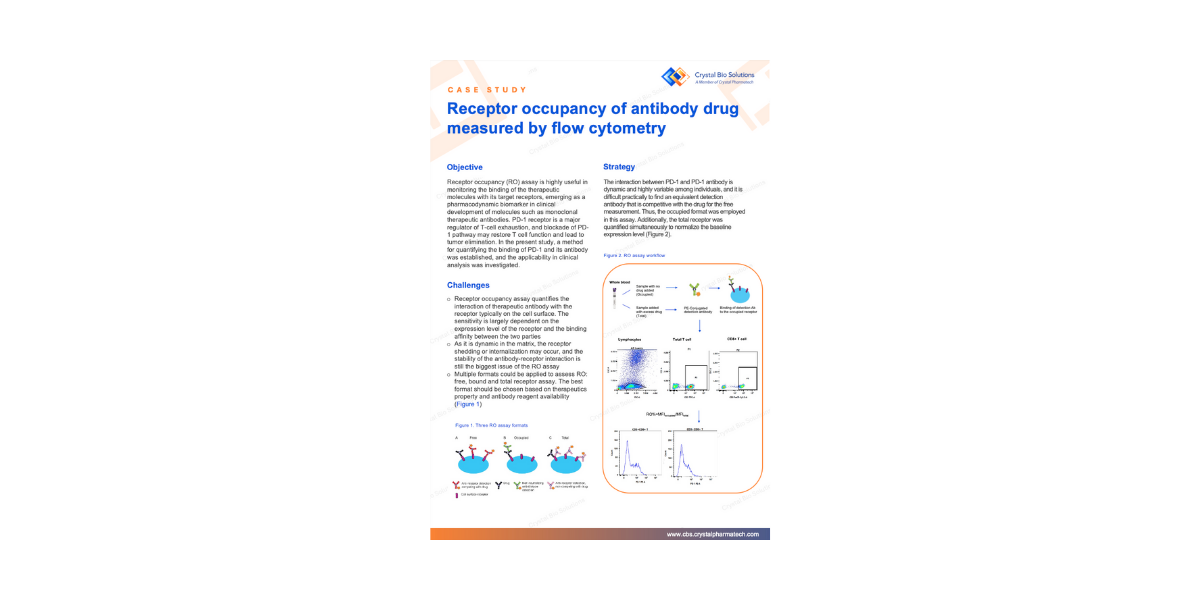
Receptor occupancy assays are used to track how therapeutic antibodies bind to their targets in vivo, making them valuable pharmacodynamic biomarkers during clinical development. In oncology, PD-1 receptor occupancy is especially critical, as blocking the PD-1 pathway can restore T-cell function and drive tumor elimination.
At Crystal Bio Solutions, our experts established a flow cytometry–based RO assay to measure PD-1 receptor binding and validated its applicability in clinical analysis. By employing the occupied receptor format alongside total receptor quantification, the assay provided reliable and precise readouts while accounting for baseline receptor expression variability.
This innovative approach helps researchers evaluate drug engagement, pharmacodynamics, and the impact of immunogenicity in clinical development.
The Challenge of Measuring Drug–Receptor Binding
Developing a robust RO assay obstacles:
- Sensitivity depends on receptor expression and antibody–receptor affinity
- Receptor shedding and internalization can affect stability of interactions
- Multiple assay formats exist (free, bound, total), but each has limitations depending on therapeutic properties and reagent availability
For PD-1 specifically, identifying a detection antibody competitive with the therapeutic drug was not feasible, making the occupied receptor format the optimal choice.
Establishing a PD-1 Receptor Occupancy Assay: A Case Study
Our experts designed a flow cytometry assay using the occupied format, while simultaneously quantifying total receptor levels to normalize baseline expression. This dual-measurement approach ensured that results remained accurate even when receptor expression fluctuated during drug treatment.
The validated assay demonstrated:
- Good intra- and inter-run precision across high, medium, and low QC levels (CV% <8%)
- Drug-dependent linearity confirming assay reliability across a relevant concentration range
- Sample stability up to 3 days post-collection, supporting clinical feasibility
These results confirm that the PD-1 RO assay can deliver consistent and interpretable pharmacodynamic data in clinical settings.
Why Receptor Occupancy Matters in Drug Development
RO is an essential PD biomarker that helps interpret drug effects, optimize dosing, and understand PK/PD relationships. For PD-1–targeting therapies, receptor occupancy helps clarify how effectively the drug engages its target and informs strategies to manage anti-drug antibody (ADA) effects.
By advancing RO assay development, our team supports biopharma partners in generating the data they need to de-risk clinical programs, accelerate regulatory submissions, and bring life-changing therapies to patients.
Key Takeaways
- Successfully established a PD-1 RO assay in the occupied format
- Simultaneous total receptor measurement reduces variability from baseline expression shifts
- Validated with strong precision, linearity, and stability across QC levels
- Provides a reliable pharmacodynamic biomarker to guide oncology drug development and PK/PD interpretation
📥📎 Access the case study