
改善ADA检测药物耐受性的样本预处理方法
转载自企业官方网站。作者及内容来源:Crystal Bio Solutions.
Crystal Bio Solutions技术文章:改善ADA检测药物耐受性的样本预处理方法。 本文保留原始技术观点、参考资料和来源链接;全文按英文原文转载。
中文导读与摘要;下方正文为英文原文,并非完整中文译文。
本文为Crystal Bio Solutions发布的英文技术文章,以下按英文原文转载,尚未提供中文全文翻译。原始日期为2025-09-16。
Originally published by Crystal Bio Solutions. Republished with company attribution. Original technical perspectives, references and source links are retained.
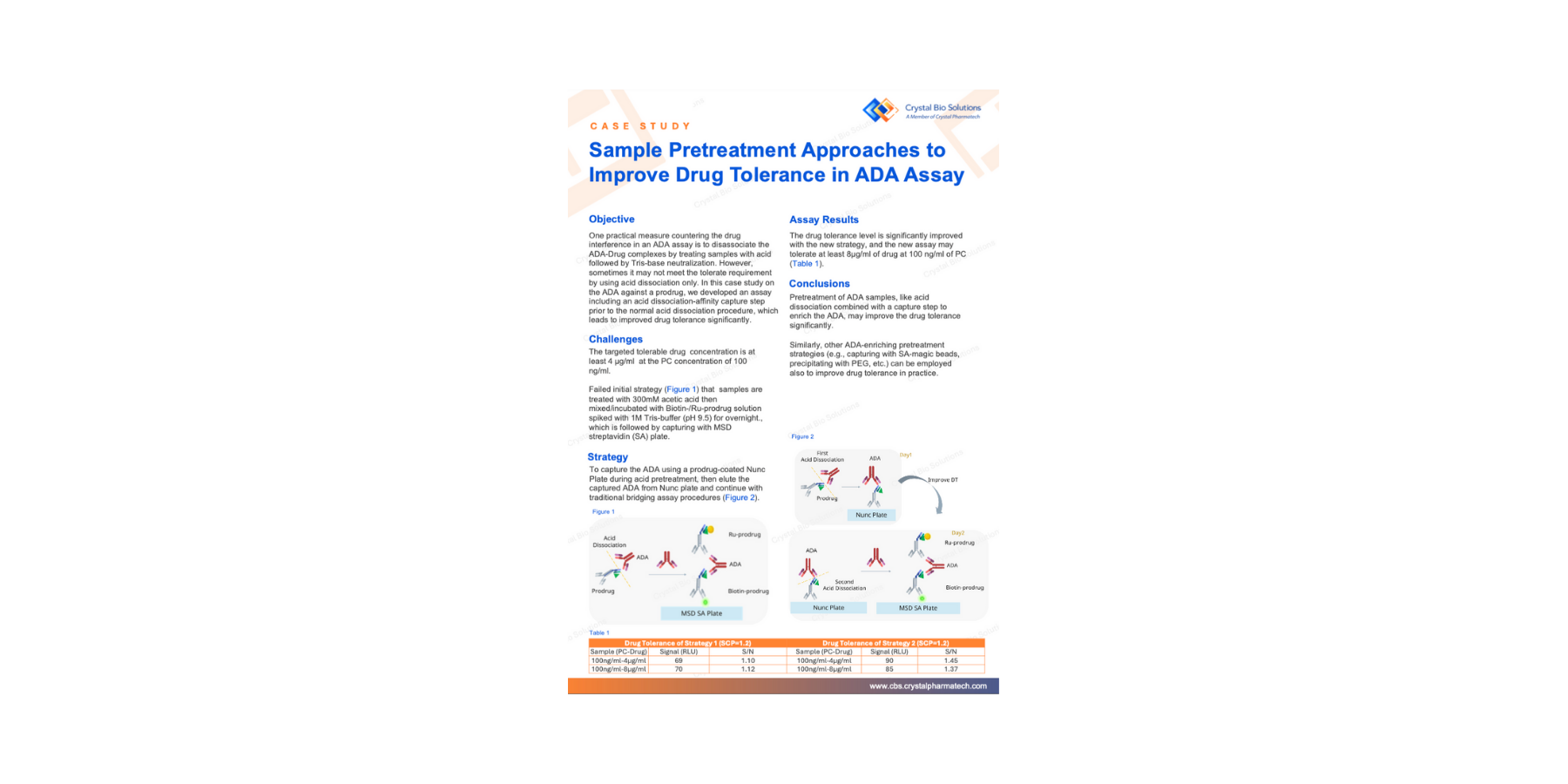
Detecting anti-drug antibodies (ADA) in the presence of high drug levels is one of the most common and complex challenges in bioanalysis. Drug–ADA complexes often mask detection, leading to underestimation of immune responses and potential risks in clinical development.
Our expert team at Crystal Bio Solutions addresses these challenges by designing and validating innovative workflows that go beyond standard methods. By introducing an acid dissociation–affinity capture step, the assay’s drug tolerance improved from 4 µg/ml to 8 µg/ml at 100 ng/ml PC. This innovative approach provides a robust path forward for immunogenicity testing in complex therapeutic settings.
ADA Assay Development: The Challenge of Drug Interference
In this project, we developed an ADA assay for a prodrug with stringent drug tolerance requirements. The target tolerance level was at least 4 µg/ml at 100 ng/ml positive control concentration (PC). Traditional acid dissociation workflows, which disrupt ADA–drug complexes by acid treatment and neutralization, were not sufficient to meet this threshold.
Improving Drug Tolerance in ADA Assays: A Case Study
To improve sensitivity, our experts implemented an acid dissociation–affinity capture step before the standard acid dissociation procedure. By capturing ADA on a prodrug-coated plate during pretreatment and then eluting it for continuation in the bridging assay, we were able to significantly enrich ADA detection and reduce drug interference.
Doubling Drug Tolerance in ADA Assay Performance
The new workflow showed marked improvement in drug tolerance, reaching at least 8 µg/ml drug tolerance at 100 ng/ml PC concentration, which is a two-fold increase compared to the traditional approach. This outcome demonstrates how integrating enrichment strategies during pretreatment can unlock higher assay performance and reliability.
Why Drug Tolerance Matters in Immunogenicity Testing
Drug tolerance is critical for accurate ADA detection in both preclinical and clinical studies. Insufficient tolerance can mask immune responses, delay development, or lead to inaccurate safety assessments. By advancing assay design beyond conventional workflows, our team helps biotech and pharma partners de-risk immunogenicity studies and accelerate regulatory submissions.
📥📎 Access the case study