
用于寡核苷酸药代动力学生物分析的LC-MS/MS方法
转载自企业官方网站。作者及内容来源:Crystal Bio Solutions.
Crystal Bio Solutions技术文章:用于寡核苷酸药代动力学生物分析的LC-MS/MS方法。 本文保留原始技术观点、参考资料和来源链接;全文按英文原文转载。
中文导读与摘要;下方正文为英文原文,并非完整中文译文。
本文为Crystal Bio Solutions发布的英文技术文章,以下按英文原文转载,尚未提供中文全文翻译。原始日期为2025-09-16。
Originally published by Crystal Bio Solutions. Republished with company attribution. Original technical perspectives, references and source links are retained.
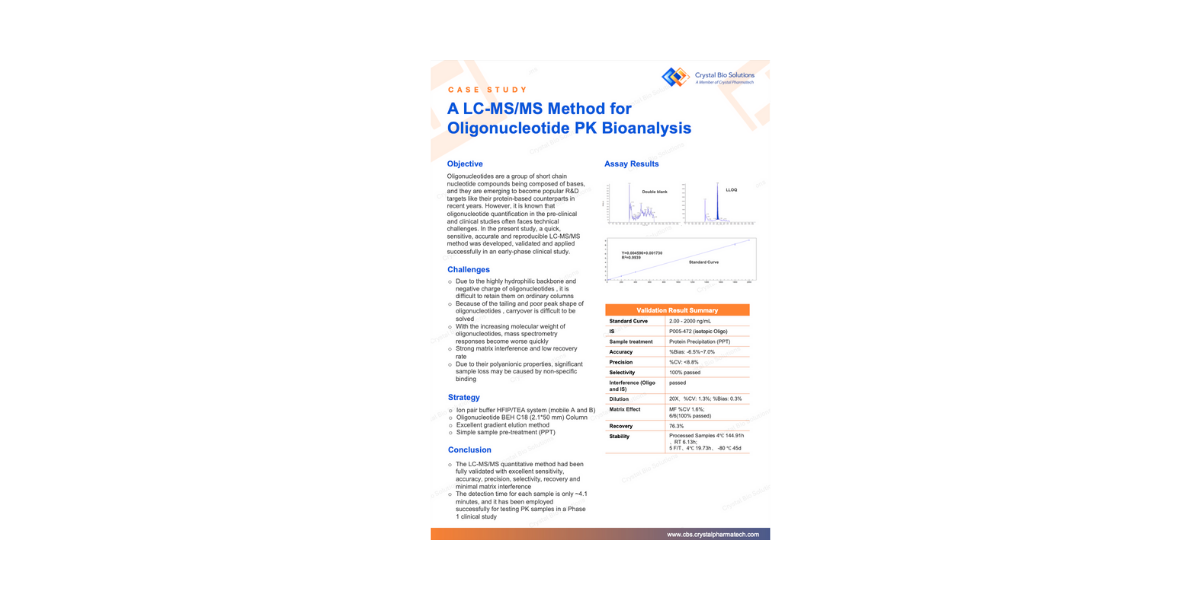
Oligonucleotides are rapidly emerging as promising therapeutic modalities, but their PK bioanalysis poses unique technical challenges. Their highly hydrophilic backbones, negative charges, and tendency for non-specific binding often result in poor retention, weak MS responses, strong matrix interference, and sample loss. Our expert team at Crystal Bio Solutions develops and validates specialized LC-MS/MS workflows that overcome these challenges, enabling reliable, high-throughput PK studies for novel oligonucleotide therapies.
By applying an optimized ion-pair buffer system, a column, and a simple protein precipitation pretreatment, our validated method achieved excellent sensitivity, recovery, and stability, delivering robust results with a runtime of just 4.1 minutes per sample.
The Challenge of Oligonucleotide PK Bionalysis
Quantifying oligonucleotides in preclinical and clinical settings is notoriously difficult. Key challenges include:
- Poor retention on ordinary columns due to hydrophilic backbones
- Peak tailing and carryover issues
- Decreasing MS response with increasing molecular weight
- Strong matrix interference and low recovery rates
- Sample loss caused by non-specific binding
Developing a Robust LC-MS/MS Method for Oligonucleotides: A Case Study
To address these issues, our experts designed a workflow based on:
- Ion-pair buffer system for improved retention and signal
- Column (2.1×50 mm) for sharp peak resolution
- Gradient elution to optimize separation
- Simple protein precipitation (PPT) pretreatment for cleaner samples
This method was fully validated with excellent performance in sensitivity, accuracy, precision, selectivity, recovery, and minimal matrix interference.
Sensitive, Accurate, and Fast Oligonucleotide PK Analysis
The validated method demonstrated:
- Standard curve: 2.00 – 2000 ng/mL (R² = 0.9939)
- Accuracy (%Bias): -6.5% to 7.0%
- Precision (%CV): <8.8%
- Recovery: 76.3%
- Stability: up to 45 days at -80°C, 144.9h at 4°C
- Runtime: ~4.1 minutes per sample
This approach was successfully applied in a Phase 1 clinical study, enabling reliable PK profiling of oligonucleotide drug candidates.
Why PK Analysis Matters for
Oligonucleotide
Accurate PK analysis is essential for understanding the absorption, distribution, metabolism, and excretion of oligonucleotide-based drugs. Without validated, high-throughput methods, development can be slowed by unreliable data or regulatory setbacks. Our workflow provides a proven solution to accelerate clinical development while ensuring data quality and compliance.
📥📎 Access the case study