
ADA检测中代表性混合基质选择的重要性
转载自企业官方网站。作者及内容来源:Crystal Bio Solutions.
Crystal Bio Solutions技术文章:ADA检测中代表性混合基质选择的重要性。 本文保留原始技术观点、参考资料和来源链接;全文按英文原文转载。
中文导读与摘要;下方正文为英文原文,并非完整中文译文。
本文为Crystal Bio Solutions发布的英文技术文章,以下按英文原文转载,尚未提供中文全文翻译。原始日期为2025-09-18。
Originally published by Crystal Bio Solutions. Republished with company attribution. Original technical perspectives, references and source links are retained.
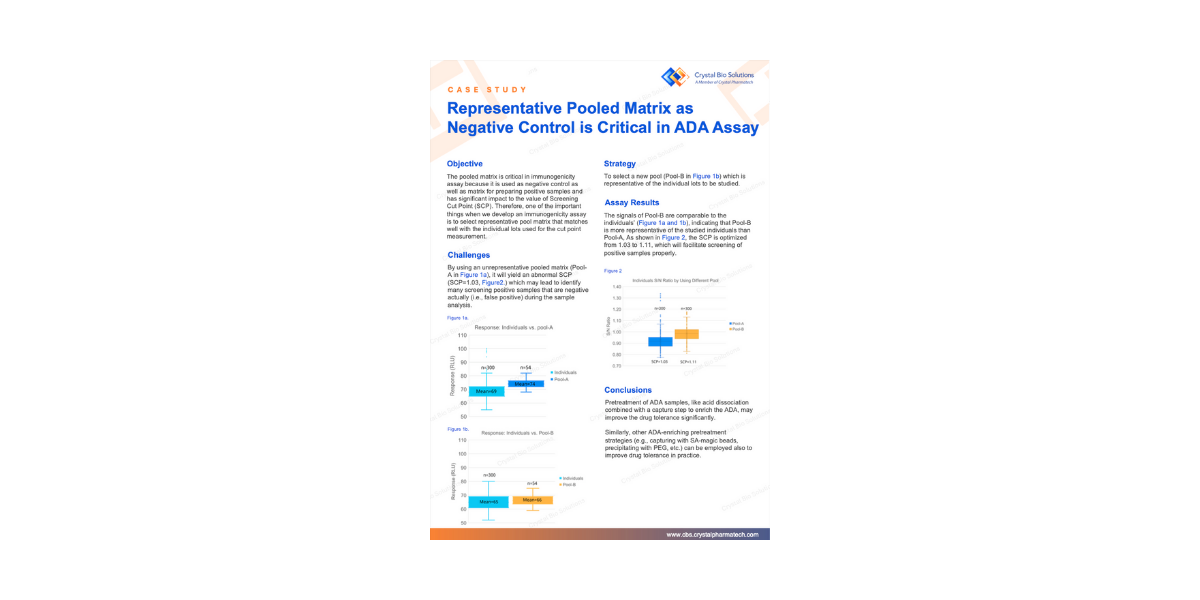
In immunogenicity testing, the pooled matrix (e.g., human serum, plasma in which antibodies or analytes are measured) serves both as the negative control and as the matrix for preparing positive control samples. Its quality directly impacts the screening cut point (SCP),a key parameter for distinguishing true positive from negative samples.
At Crystal Bio Solutions, our experts evaluated how different pooled matrices influence ADA assay performance and demonstrated that an unrepresentative pool can skew SCP values, leading to excessive false positives. By carefully selecting a more representative pooled matrix, we improved assay accuracy and ensured more meaningful immunogenicity results.
The Challenge of Using Unrepresentative Pooled Matrices
When an unrepresentative pooled matrix is used in ADA testing, the resulting SCP can fall abnormally low.
- In this case, Pool-A produced an SCP of 1.03, which would have incorrectly flagged many negative samples as positive.
- Such outcomes not only distort immunogenicity assessments but can also delay drug development by raising false safety concerns.
Establishing a Representative Pooled Matrix: A Case Study
Our experts compared multiple pooled matrices to identify one that better matched individual serum lots used in cut point determination.
- Pool-B showed signals consistent with the individual lots.
- As a result, the SCP shifted from 1.03 to 1.11, a more accurate value that better reflects true immunogenicity outcomes.
This simple but critical adjustment ensures that screening identifies positive samples appropriately while minimizing false positives.
Improved Accuracy and Reliability in ADA assay
The validated approach confirmed that:
- Pool-B was representative of individual samples, aligning closely with their baseline signals.
- The optimized SCP (1.11) allowed for more accurate ADA screening.
- False positives were reduced, improving the reliability of immunogenicity assessments in therapeutic protein development.
Why Pooled Matrix Selection Matters in ADA Assays
Immunogenicity evaluation is a cornerstone of biologic drug development. Using a poorly matched pooled matrix can undermine the accuracy of ADA assays, creating unnecessary hurdles in clinical development. By selecting a representative pooled matrix, our team helps ensure robust cut point determination, avoid false positives and provide confident decision-making in immunogenicity studies.
Key Takeaways
- Established the importance of using a representative pooled matrix in ADA assays
- Demonstrated that Pool-B provided signals consistent with individual serum lots
- Optimized the screening cut point from 1.03 to 1.11, improving accuracy
- Reduced false positives, delivering more reliable immunogenicity testing outcomes
📥📎 Access the case study