
减少可溶性靶蛋白干扰的免疫原性分析策略
转载自企业官方网站。作者及内容来源:Crystal Bio Solutions.
Crystal Bio Solutions技术文章:减少可溶性靶蛋白干扰的免疫原性分析策略。 本文保留原始技术观点、参考资料和来源链接;全文按英文原文转载。
中文导读与摘要;下方正文为英文原文,并非完整中文译文。
本文为Crystal Bio Solutions发布的英文技术文章,以下按英文原文转载,尚未提供中文全文翻译。原始日期为2025-09-18。
Originally published by Crystal Bio Solutions. Republished with company attribution. Original technical perspectives, references and source links are retained.
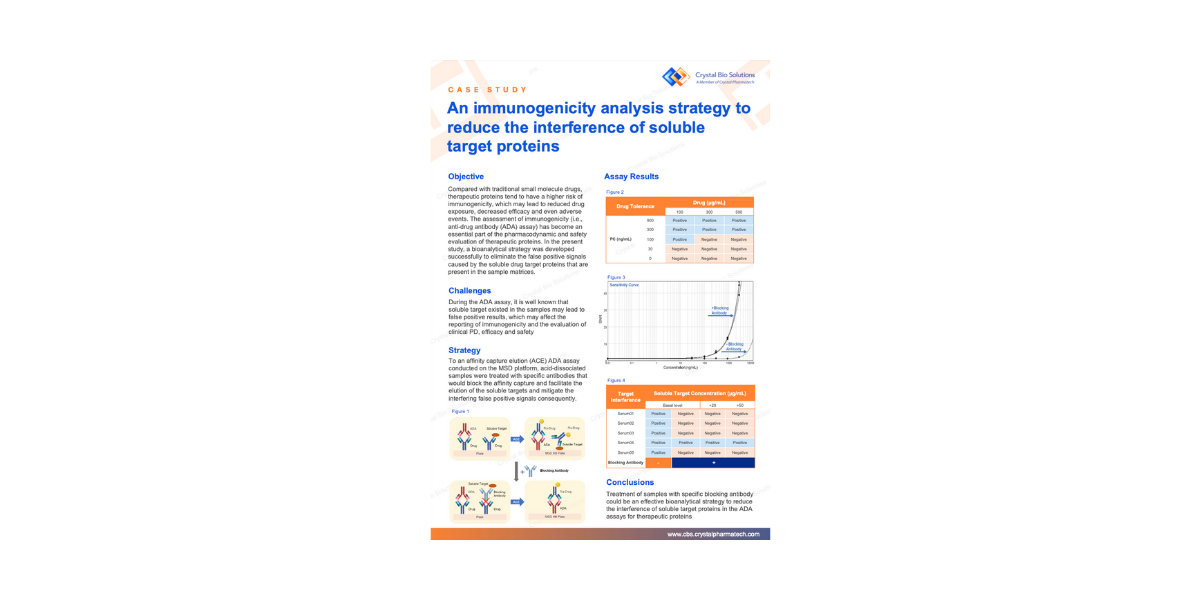
Compared with traditional small molecule drugs, therapeutic proteins carry a higher risk of immunogenicity, which can reduce exposure, decrease efficacy, or even trigger adverse events. Accurate anti-drug antibody (ADA) assays are essential for evaluating pharmacodynamics and safety.
One major challenge in ADA testing is that soluble target proteins in patient samples can interfere with the assay, producing false positives that misrepresent immunogenicity risk.
At Crystal Bio Solutions, our experts established a blocking antibody strategy to overcome this challenge and validated it on the MSD platform. By treating acid-dissociated samples with a specific antibody that blocks affinity capture, we were able to remove soluble target interference and reduce false positive signals. This approach provides a more reliable basis for immunogenicity evaluation in therapeutic protein development.
The Challenge of Soluble Target Interference in ADA Testing
During ADA assays, soluble target proteins circulating in serum can bind in ways that mimic ADA signals, leading to false positives. This not only complicates data interpretation but may also misguide decisions on clinical pharmacodynamics, efficacy, and safety.
Developing a Blocking Antibody Strategy: A Case Study
To address this, our experts integrated a blocking antibody step into an ACE (affinity capture elution) ADA assay workflow:
- Acid dissociation to release ADA from complexes
- Blocking antibody treatment to neutralize soluble targets before capture
- MSD-based detection to quantify ADA accurately without interference
This strategy effectively distinguished true ADA signals from target-related artifacts.
Reliable Immunogenicity Data Without False Positives
The validated workflow showed:
- Strong drug tolerance across multiple concentrations (100–500 µg/mL) with positive ADA detection at high positive control levels
- Clear reduction of false positives in samples with elevated soluble target concentrations when blocking antibody was applied
- Consistent results across multiple serum samples, confirming robustness of the approach
Why Target Interference Matters in Immunogenicity Assessment
For therapeutic proteins, immunogenicity assessment is critical to ensure patient safety and clinical efficacy. False positives from soluble target interference can lead to overestimation of immunogenicity risk, delaying development or complicating regulatory submissions. By reducing this interference, our strategy ensures ADA assays produce accurate, reliable data, helping biopharma teams move forward with confidence.
Key Takeaways
- Developed a blocking antibody strategy to mitigate soluble target interference in ADA assays
- Successfully applied within an ACE assay on the MSD platform
- Validated with robust drug tolerance and reduced false positives across serum samples
- Provides a more accurate and reliable approach for immunogenicity assessment in therapeutic protein development
📥📎 Access the case study